Whether you’re planning to get a membership at a local pool, take a family beach vacation or spend your days at the lake, chances are your kids will encounter a new swimming opportunity at some point this summer.
As moms, we look forward to these adventures, but they can also be stressful. Making sure everyone is safe is a top priority. Not to mention the endless supply of sunscreen, snacks, and swimsuits these activities require.
But, it’s all worth it. Looking back at my own childhood, I have so many great memories of 4th of July pool parties, family reunions at the lake, and waterskiing at sleepaway camp.
Whatever adventures you have planned, here are my tips for a safe summer.
Trip Planning With Water Safety In Mind
When you are deciding where to stay on vacation, a pool or hot tub is a major consideration. A hotel with an indoor pool is the perfect way to burn off energy on a road trip.
By law, hotel pools will have a fence with a self-closing gate. However, an Airbnb or similar rental may not have the same protection.
Tip #1: If you don’t have confident swimmers, look for TWO barriers between your family and the water.
For example, your hotel room has a door and the pool is enclosed with a fence.
Gates, hot tub covers, and fences are even more important than door chimes or similar alert systems. A door can be left open, a curious toddler can figure out how to unlock a door and a chime can go undetected in the chaos of family life.
Kids are naturally curious and often eager to explore a new environment. Swimming lessons are important, but no swimming program is capable of “drown-proofing” a child of any age. It is essential to block access to pools or other sources of water during non-swim times.
Two physical barriers will give you peace of mind and offer better protection for your family.
Tip #2: Put Your Lifejacket On Before You Get to the Swimming Area
Your lifejacket only works if you are wearing it. Have kids put their life jackets on before they step on the dock, enter the pool area or head down to the water.
It’s easy for an excited kiddo to jump into the pool before you are ready or to fall in as you set your things down. Plus, if your child is wearing their life jacket, that’s one less thing for you to carry!
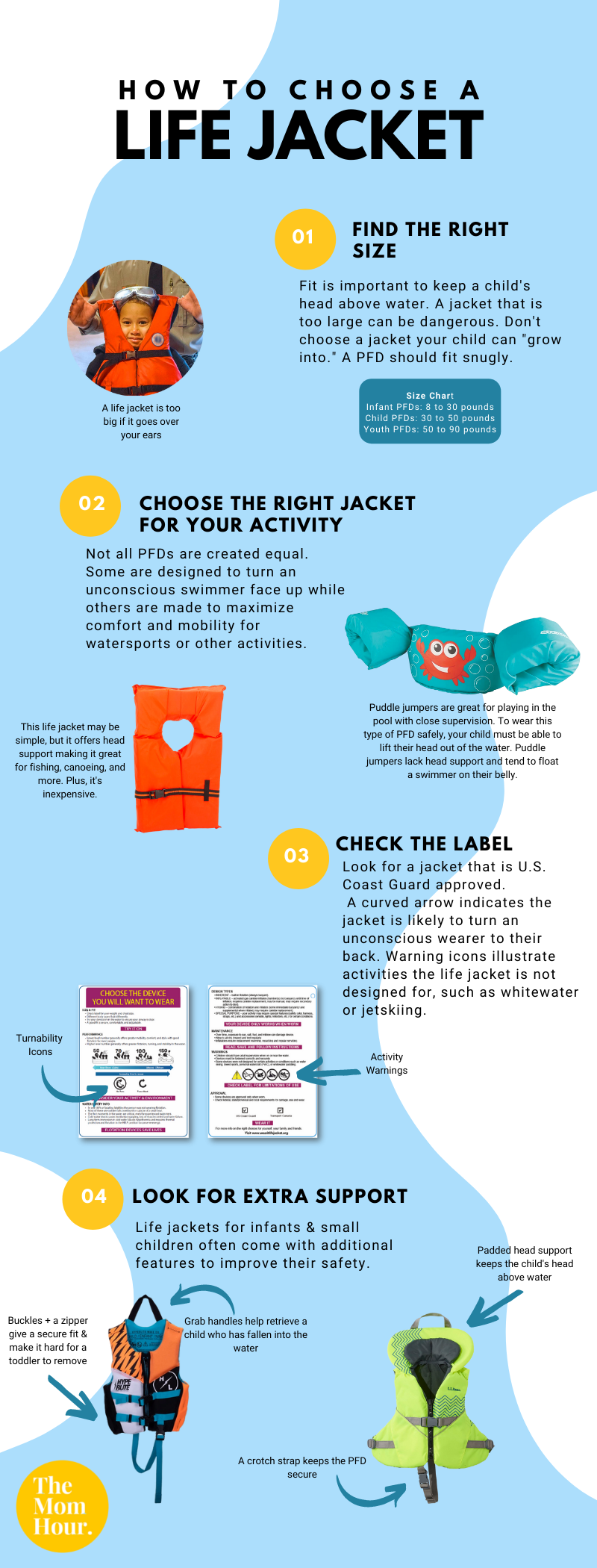
Having the right life jacket is key. Check out the infographic below for some general guidelines.
Make Your Child’s Jacket As Comfortable As Possible
We’ve found that a long-sleeve rash guard prevents chafing under the arms on days at the lake when we are wearing our life jackets for long periods of time. When we are on the boat, my daughter wears a rash guard with separate bottoms so we don’t need to unbuckle her life jacket for a potty break. Most jackets for small children come with a strap that goes between their legs. It’s tempting to skip it, but that additional strap is especially important to keep the life jacket secure.
Tip #3: Communicate Hand Offs
For the past two summers, my twins have teetered on the edge of being able to swim independently. When I was solo in the water with them, I would have them wear their life jackets because it was too much to manage on my own. But, when my husband or another adult was in the water with us, I wanted them to practice swimming without their life jackets.
So, we developed a dorky but effective system to hand off responsibility. When one of the twins would swim away I would say:
“You have Harper.” My husband would repeat back, “I have Harper” to confirm that she was now his responsibility.
Maybe this is a twin thing? All I know is that this really helped with multiple kids in the water.
Whenever inexperienced swimmers are in or around water, an adult – ideally one who knows how to swim and perform CPR – should be within arm’s length, providing “touch supervision.”
Tip #4: Use a Buddy System
This applies to older kids and grown-ups. Don’t swim alone. If tweens and teens want to explore the water park while you read a book, that’s great. Send them off in pairs.
Even with adult supervision or a lifeguard, the buddy system is a great idea, especially in large areas like the lake or ocean.
Good parents can lose sight of their kids. I lost my daughter at an Easter Egg hunt in someone’s backyard surrounded by other moms. If someone goes missing, always check the pool first. (Thankfully, my daughter was inside the house hiding in a play tent.)
Tip #5: Everyone is watching…no one is paying attention.
At pool parties, BBQs and family gatherings there are often a number of adults around. This can give us a false sense of security.
Everyone is sitting around the pool, but often, no one is actively paying attention. It’s easy to be distracted checking on food or visiting with friends.
If you are the host, consider hiring a lifeguard. If that’s not an option, designate a water watcher. This person sits close enough to the pool to see the bottom, does not chat with other adults and is not under the influence of alcohol. Rotate adults every 20 mins so no one gets complacent and everyone has a chance to enjoy the gathering.
A swimmer in distress is not likely to call for help. They are most often vertical in the water, with their head tilted back. Their arms and legs look as if they are climbing an invisible ladder.
I hope these tips help you and your family enjoy time in the water this summer. Watching your child learn to swim and enjoy all kinds of water activities is a rewarding experience.
Active supervision, swimming lessons, fences, and lifejackets are the most important tools we have as parents to help keep our children safe in and around the water.
More About The Author
In addition to her work as a freelance writer (and contributor to The Mom Hour!), Jennifer Carroll loves to spend time in the water with family and friends. She got her start as a lifeguard and has continued to teach swimming lessons for the past 20 summers.
Jennifer met her husband on Oklahoma State’s wakeboarding team and was a boat driver, waterskiing, and wakeboarding instructor at sleep-away camps in New York and Texas.
Jennifer has earned her:
- American Red Cross Lifeguard Certification
- American Red Cross Water Safety Instructor Certification
- Open Water Rescue Certification
- American Heart Association Basic Life Support Certification
- Aquatic Exercise Instructor Certification
Recommended Resources
